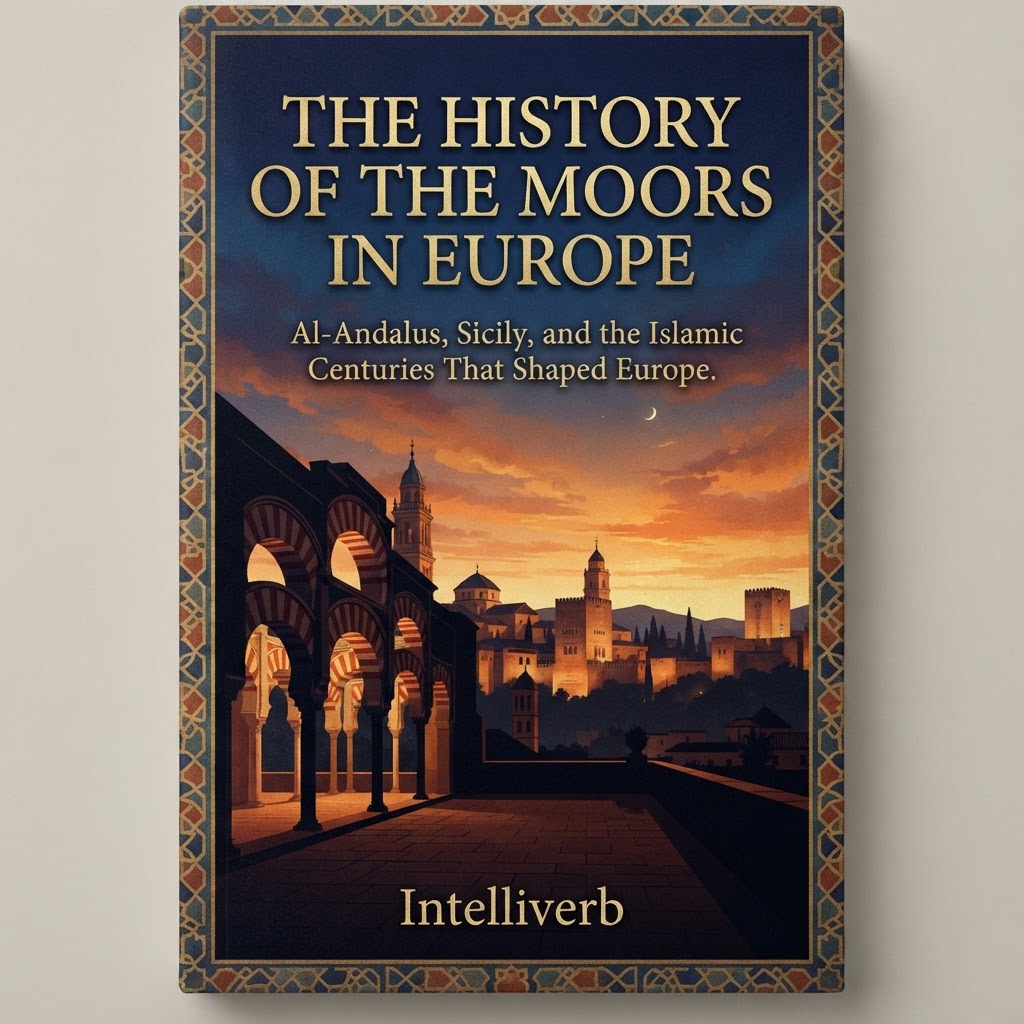
The History of the Moors in Europe
Al-Andalus, Sicily, and the Islamic Centuries That Shaped Europe
A comprehensive history of the Moors in Europe, from the Berber and Arab conquests of 711 through the Caliphate of Córdoba, the taifas, the Almoravid and Almohad empires, Muslim Sicily and southern Italy, the Nasrid kingdom of Granada, and the expulsions that ended Islamic rule in western Europe.
Chapters
Chapter 1: Who Were the Moors? A Name, a People, and a Legacy
The origin and shifting meaning of the word 'Moor' from Roman Mauretania through Latin, Greek, and Arabic usage, the Berber and Arab peoples it described, and why the term resists simple definition.
Chapter 2: Before the Conquest: North Africa, the Berbers, and the Rise of Islam
The Maghreb before Islam, Berber societies and kingdoms, the seventh-century Arab conquests, the Kairouan frontier, and the conversion and integration of Berber tribes into the Umayyad world.
Chapter 3: The Crossing of the Strait: 711 and the Fall of Visigothic Iberia
Visigothic Spain and its internal collapse, the expeditions of Tariq ibn Ziyad and Musa ibn Nusayr, the battles of Guadalete, and how a small expeditionary force came to hold most of the peninsula within a decade.
Chapter 4: Al-Andalus Ascendant: Emirate, Caliphate, and Córdoba
The Umayyad emirate of Abd al-Rahman I, the fitna, the proclamation of the caliphate by Abd al-Rahman III, and the political structure of the most powerful state in western Europe.
Chapter 5: Córdoba of the Caliphs: Libraries, Scholars, and the Translation Movement
Madinat al-Zahra, the great library, paper making, the circle of scholars, and how Córdoba became a conduit through which Greek, Persian, and Indian learning entered Latin Europe.
Chapter 6: Convivencia and Its Limits: Muslims, Jews, and Christians in Medieval Iberia
The dhimmi system, interfaith scholarly exchange, the Mozarabs, the 1066 Granada massacre, and a critical look at the romantic myth of harmonious coexistence.
Chapter 7: Agriculture, Water, and Craft: How the Moors Reshaped the Landscape
Irrigation systems, the noria and acequia, introduced crops such as citrus, rice, sugarcane, and cotton, mining, ceramics, textiles, and urban planning in Iberian towns.
Chapter 8: The Taifa Kingdoms and the Coming of the Almoravids
The collapse of the caliphate into rival taifas, cultural patronage and political fragmentation, the fall of Toledo in 1085, and the Saharan Almoravid intervention after Sagrajas.
Chapter 9: The Almohads: Reform, Empire, and Las Navas de Tolosa
The Almohad revolution in North Africa, their entry into Iberia, the height of Almohad power at Alarcos, and the catastrophic defeat of 1212 that opened Andalusia to the Christian kingdoms.
Chapter 10: The Moors in Sicily and Southern Italy
The Aghlabid conquest of Sicily, the Emirate of Sicily, Palermo as a Muslim city, the Norman kingdom's Arab-Islamic administration, and the deportation of Lucera.
Chapter 11: Across the Pyrenees: Raids, Provence, and the Northern Frontier
The raids into Francia, the battle of Tours-Poitiers and its contested significance, the occupation of Septimania and Narbonne, and the long frontier society of the marches.
Chapter 12: Great Minds of Al-Andalus: Reason, Faith, and the Andalusian Tradition
Ibn Hazm, al-Zahrawi, Ibn Rushd (Averroes), Ibn Tufayl, Ibn Arabi, and Maimonides, and how Andalusian philosophy, medicine, and law shaped European thought.
Chapter 13: Granada: The Last Emirate and the Alhambra
The Nasrid kingdom, its survival through diplomacy and tribute, the Alhambra and Generalife as architecture and ideology, the civil war, and the surrender of 1492.
Chapter 14: 1492 and After: Expulsion, Moriscos, and Forced Conversion
The terms of the capitulations, the Alhambra Decree, the 1502 conversion order, the Morisco revolts of the Alpujarras, the expulsions of 1609 to 1614, and the human cost of erasure.
Chapter 15: The Moorish Legacy in Europe: Language, Architecture, Music, and Memory
Arabic loanwords in Spanish and Portuguese, the mudéjar style and its influence, flamenco and musical exchange, place names, and how the Moorish past is remembered, contested, and romanticized today.