Diagnostic Treatment in Primary Care by Family Nurse Practitioner
Chapter 1 of 15 • 8m
Chapter 1: Introduction to Diagnostic Reasoning in Primary Care
Overview of the diagnostic process, clinical decision-making frameworks, differential diagnosis, and the FNP's role in primary care diagnostics.
Chapter 1: Introduction to Diagnostic Reasoning in Primary Care
Introduction
The hallmark of the Family Nurse Practitioner (FNP) in primary care is the ability to navigate uncertainty while delivering safe, evidence-based care. Unlike the acute care setting, where the focus is often on stabilization and immediate pathology, primary care diagnostic reasoning is a longitudinal process. It requires the clinician to synthesize subtle clinical data, patient values, and epidemiological probabilities to identify both common conditions and "red flag" emergencies.
Diagnostic reasoning is not a linear path but a cognitive art form—a dynamic interaction between the practitioner’s knowledge base and the patient’s narrative. For the FNP, diagnostic excellence requires moving beyond pattern recognition (System 1 thinking) toward analytical, hypothesis-driven assessment (System 2 thinking) to minimize cognitive biases. This chapter provides the foundational framework for rigorous diagnostic inquiry, ensuring that every encounter is an opportunity to improve patient outcomes through precise clinical decision-making.
The Cognitive Architecture of Clinical Decision-Making
Effective diagnostic reasoning relies on Dual Process Theory. Understanding these mechanisms helps the FNP avoid diagnostic errors, which are frequently rooted in cognitive biases such as premature closure or anchoring.
1. System 1: Intuitive Thinking
This is the rapid, pattern-recognition process. When an FNP recognizes the "classic" presentation of streptococcal pharyngitis or seasonal allergies, they are utilizing System 1. While efficient, it is highly susceptible to cognitive errors if the patient’s presentation is atypical.
2. System 2: Analytical Thinking
This process is slow, deliberate, and evidence-based. It involves gathering comprehensive data, generating a list of differential diagnoses, and testing hypotheses. FNPs must consciously shift to System 2 when:
- The patient’s symptoms are vague or multisystemic.
- The initial diagnosis fails to respond to standard treatment.
- The patient presents with "red flags" suggesting serious underlying pathology.
Clinical Pearl: Mitigating Bias
To avoid premature closure (stopping the diagnostic process too early), always ask yourself: "What else could this be? What is the most dangerous condition that could explain these symptoms?"
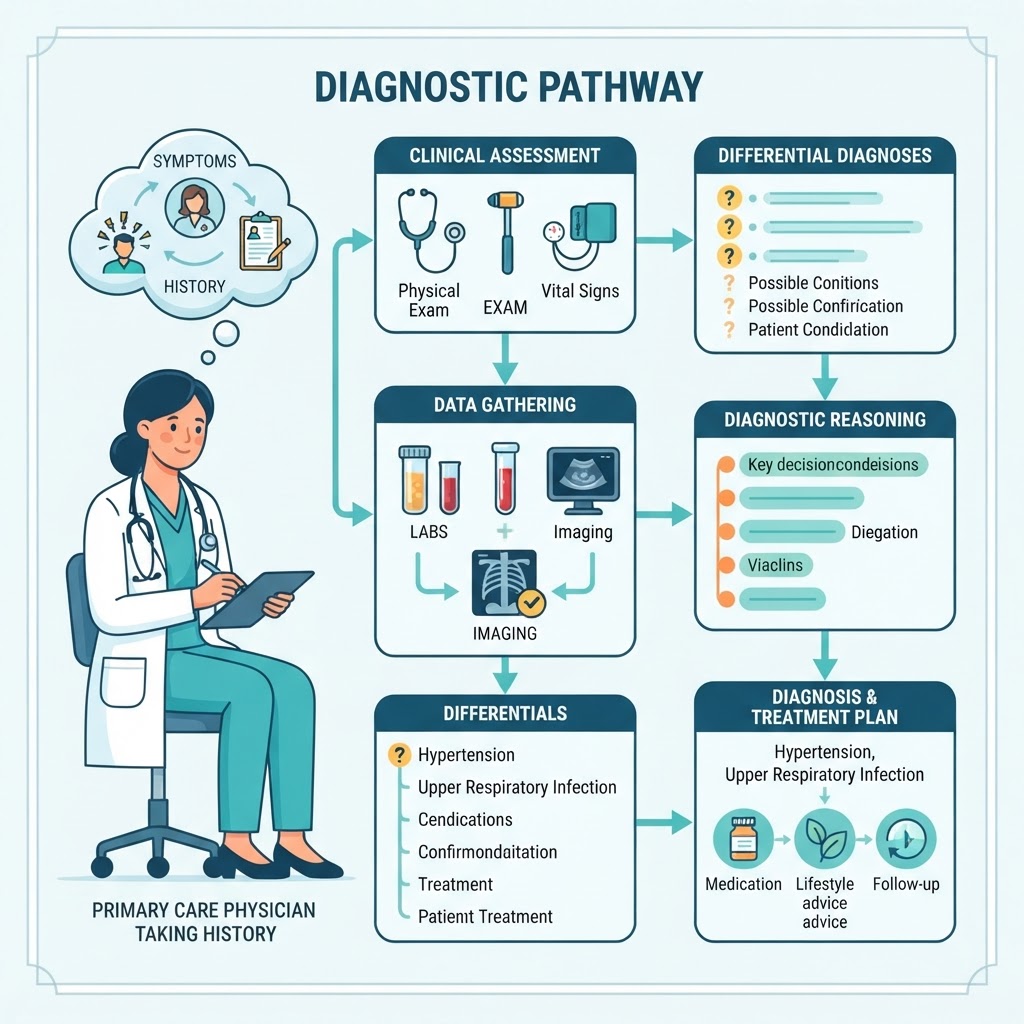
The Diagnostic Process: From Chief Complaint to Conclusion
The diagnostic journey in primary care follows a structured sequence, yet remains flexible enough to accommodate the complexities of human health.
Step 1: Data Gathering (The Narrative)
The history of present illness (HPI) remains the most critical diagnostic tool. Utilize the OLD CARTS mnemonic (Onset, Location, Duration, Character, Aggravating/Alleviating factors, Radiation, Timing, Severity) to create a granular clinical picture.
Step 2: The Physical Examination
In primary care, the exam must be targeted toward the differential diagnosis. A "head-to-toe" exam is often less useful than a hypothesis-driven exam. If a patient presents with abdominal pain, the FNP should focus on visceral vs. parietal triggers, maneuvers like the Psoas or Obturator signs, and a thorough assessment of bowel sounds and bruits.
Step 3: Hypothesis Generation and Differential Diagnosis
Once data is collected, the FNP must create a ranked list of differential diagnoses. The top three should include:
- The most likely diagnosis: Based on prevalence and patient history.
- The "Must-Not-Miss" diagnosis: The most serious, life-threatening pathology that must be ruled out.
- The "Common but Complex" diagnosis: A chronic condition that requires management.
Diagnostic Criteria and Interpretation
Evidence-based practice (EBP) mandates that FNPs utilize validated diagnostic criteria rather than relying on subjective clinical impression alone.
Utilizing Clinical Decision Rules (CDRs)
CDRs are algorithmic tools designed to assist in decision-making. Examples include:
- Centor Criteria: Used for identifying the probability of Group A Beta-Hemolytic Streptococcus (GABHS).
- Ottawa Ankle Rules: Validated guidelines for determining the necessity of radiographs after an ankle injury.
- Wells Criteria: Used to estimate the clinical probability of Pulmonary Embolism (PE) or Deep Vein Thrombosis (DVT).
Lab and Imaging Interpretation: The FNP Standard
Diagnostics should only be ordered if the results will change the clinical management plan. The FNP must be adept at interpreting "gray zone" results:
- Sensitivity vs. Specificity: A highly sensitive test (e.g., D-dimer) is excellent for ruling out a disease (SnNout). A highly specific test (e.g., biopsy) is excellent for ruling in a disease (SpPin).
- Incidentalomas: In an era of advanced imaging, incidental findings are common. Before ordering an MRI or CT, discuss the likelihood of finding "incidental" anomalies that may lead to unnecessary anxiety, further invasive testing, and increased costs for the patient.
The FNP’s Role: Integrating Patient-Centered Care
The FNP occupies a unique role that blends the nursing model of care—holistic, patient-centered, and health-promotion focused—with the medical model of diagnostic inquiry.
Shared Decision-Making
Diagnostic reasoning in primary care is a collaborative endeavor. Once the differential diagnosis is established, the FNP should present the options to the patient, including:
- The risks and benefits of diagnostic testing.
- The "watchful waiting" approach, if appropriate.
- The cost implications.
The "Watchful Waiting" Protocol
In primary care, not all symptoms require an immediate diagnostic test. Many self-limiting viral illnesses or minor musculoskeletal aches are best managed through patient education and monitoring. Establishing clear "return-to-clinic" criteria (e.g., "If your fever persists beyond 72 hours, or if you develop shortness of breath, please return immediately") is an essential component of professional practice.
Clinical Protocols and Documentation
Accurate documentation is not only a medicolegal requirement but a diagnostic tool in itself. A clear, logical note allows the clinician to track the progression of symptoms over time, which is critical for identifying trends in chronic disease management.
Documentation Best Practices:
- SOAP Note Refinement: Ensure the "Assessment" section includes the ranked differential diagnosis. Do not simply write "Abdominal pain." Write: "Differential includes 1. GERD (Primary), 2. Peptic Ulcer Disease (Must-not-miss), 3. Cholecystitis."
- Evidence of Reasoning: Document why a specific test was or was not ordered. This provides clarity for future encounters and protects the provider during peer review.
- Communication of Results: Document when and how the patient was notified of diagnostic results. This is a common failure point in malpractice litigation.
Best Practices for the FNP in Diagnostic Excellence
- Stay Current with Clinical Guidelines: Join professional organizations like the AANP (American Association of Nurse Practitioners). Guidelines for hypertension, diabetes, and dyslipidemia are updated frequently.
- Practice Reflexivity: After a patient encounter, especially one that felt "off," spend five minutes reflecting on your diagnostic process. Did you miss a clue? Were you biased by a previous encounter with this patient?
- Engage in Interprofessional Collaboration: Do not hesitate to consult with a specialist or a physician colleague when a presentation falls outside your comfort zone. True clinical competence is defined by knowing your limits.
- Prioritize Preventative Screening: Use the USPSTF (U.S. Preventive Services Task Force) guidelines to integrate screening diagnostics into routine physical exams. Prevention is the ultimate diagnostic success.
Case Study: Application of Diagnostic Reasoning
Patient: 55-year-old female presenting with fatigue and mild epigastric discomfort.
- Initial Thought (System 1): Gastritis; prescribe a proton pump inhibitor (PPI).
- Analytical Shift (System 2): The FNP considers the patient's age and gender. While gastritis is common, the "Must-Not-Miss" is cardiac ischemia.
- Diagnostic Action: The FNP performs an EKG in the office, orders a lipid panel, and assesses cardiac risk factors (family history, sedentary lifestyle).
- Outcome: EKG shows non-specific ST-T wave changes. The FNP refers for a stress test and initiates a workup for CAD, rather than masking symptoms with a PPI.
Chapter Summary
Diagnostic reasoning is the cognitive foundation of primary care. As FNPs, we are tasked with synthesizing vast amounts of data to provide high-quality, patient-centered care. By moving from reflexive, intuitive thinking toward analytical, hypothesis-driven inquiry, we reduce diagnostic error and improve patient safety.
Key takeaways from this chapter include:
- Utilize Dual Process Theory: Consciously switch to System 2 (analytical) thinking for complex or ambiguous presentations.
- Rank Your Differentials: Always prioritize the "Must-Not-Miss" diagnosis alongside the most likely etiology.
- Leverage CDRs: Use validated clinical decision rules to guide testing, ensuring that only necessary and useful diagnostics are performed.
- Adopt Shared Decision-Making: Engage patients in the reasoning process to increase adherence and satisfaction.
- Document Rigorously: Clearly state your diagnostic reasoning in your clinical notes to facilitate longitudinal care.
By mastering the diagnostic process, the FNP ensures that every encounter is guided by logic, evidence, and a deep commitment to the health and well-being of the patient. The path to becoming an expert clinician is a lifelong journey of questioning, learning, and refining one’s analytical framework.
References and Further Reading
- American Association of Nurse Practitioners. (2023). Standards of Practice for Nurse Practitioners.
- Croskerry, P. (2013). The Importance of Cognitive Errors in Diagnosis and Strategies to Minimize Them. Academic Medicine.
- U.S. Preventive Services Task Force. (2024). Recommendations for Primary Care Practice.
- Bickley, L. S. (2021). Bates' Guide to Physical Examination and History Taking. Wolters Kluwer.
💡 Key Takeaways
- Primary care diagnostic reasoning is a longitudinal process characterized by navigating uncertainty rather than immediate stabilization.
- Effective diagnosis requires synthesizing subtle clinical data, patient values, and epidemiological probabilities.
- Clinicians must prioritize hypothesis-driven System 2 thinking over simple System 1 pattern recognition to minimize cognitive bias.
- A key responsibility of the primary care practitioner is the ability to distinguish common conditions from urgent red-flag emergencies.
🧠 Sign in to take the chapter quiz