Speaking Lingala as an English Speaker: A Comprehensive Guide
Chapter 1 of 15 • 8m
Chapter 1: Introduction to Lingala for English Speakers
Overview of the Lingala language, its history, geographic reach in Central Africa, dialectal variations, and how to set effective learning goals.
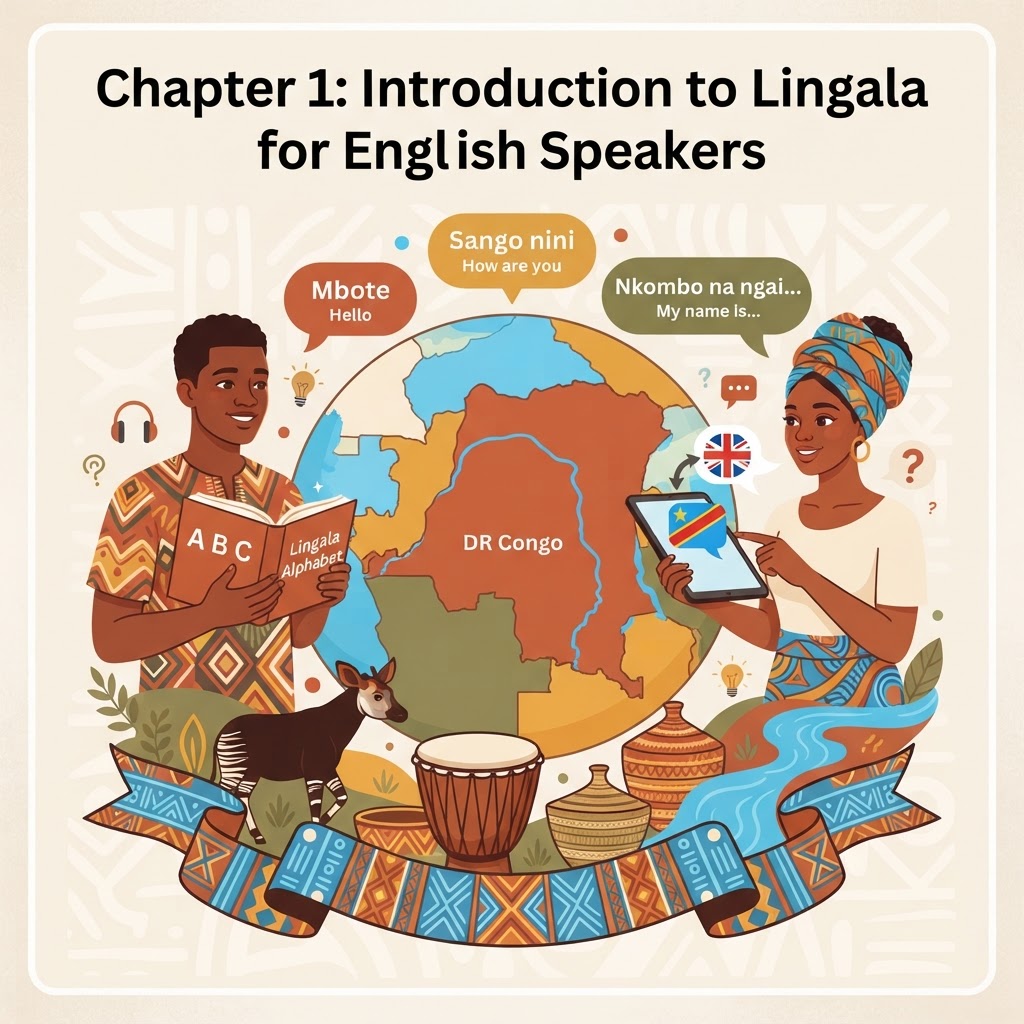
Chapter 1: Introduction to Lingala for English Speakers
Welcome to the journey of learning Lingala. Whether you are connecting with family heritage, preparing for a trip to the heart of Africa, or simply expanding your linguistic horizons, you have chosen a language that is as melodic and rhythmic as the music for which it is world-famous.
This chapter serves as your foundation. We will explore the soul of the language, its historical roots, its current global footprint, and, most importantly, how to approach your learning journey with a mindset designed for success.
1.1 What is Lingala? The Soul of the Congo
Lingala is a Bantu language, part of the Niger-Congo language family. It is primarily a lingua franca—a bridge language—used across a vast territory in Central Africa. Unlike English, which is an Indo-European language, Lingala functions on a system of noun classes, agglutinative verb structures, and a melodic tonal quality that gives it a distinct, flowing sound.
To an English speaker, Lingala might initially sound "musical." This is not a coincidence; Lingala is the primary language of Soukous (Congolese Rumba), a musical genre that has heavily influenced music across the African continent and the diaspora. When you learn Lingala, you aren't just learning words; you are learning the cadence of a region.
1.2 A Brief History: From River Trade to Global Reach
To understand Lingala, you must understand the Congo River. Historically, Lingala did not exist in its current form for thousands of years. It emerged in the late 19th century as a simplified form of Bangala, a language used for trade along the Congo River during the era of the Congo Free State.
As colonial administrators, missionaries, and river traders converged, they needed a medium to communicate. The language evolved, drawing heavily from the Bobangi language and incorporating loanwords from French, Portuguese, and English.
Today, Lingala is a primary language in:
- The Democratic Republic of the Congo (DRC): Specifically in the capital, Kinshasa.
- The Republic of the Congo (Brazzaville): It is the primary language of the capital city.
- The Diaspora: Significant communities in Belgium, France, the United Kingdom, and the United States speak Lingala, keeping the culture alive through music and community gatherings.
1.3 Geographic Reach and Dialectal Variations
One of the most important things for a beginner to realize is that Lingala is not a monolith.
- Standard/Kinshasa Lingala: This is the most widely spoken variety. If you are learning from music, news, or textbooks, this is the version you are likely encountering. It is heavily influenced by French.
- Brazzaville Lingala: While mutually intelligible with Kinshasa Lingala, there are slight differences in vocabulary and pronunciation.
- "Lingala ya Kwiti" (Street/Slang Lingala): Used by the youth in Kinshasa, this variety is dynamic and constantly changing. It incorporates many loanwords from French and creative "code-switching."
Practical Tip: Don't stress about regional dialects yet. Focus on "Standard Kinshasa Lingala." Once you have a firm grasp of the basics, you will find it incredibly easy to adapt to regional nuances.
1.4 Setting Effective Learning Goals
Learning a language requires more than just willpower; it requires a strategy. As an English speaker, you are crossing a linguistic bridge that requires a different cognitive approach.
The "S.M.A.R.T." Approach to Lingala
- Specific: Instead of "I want to learn Lingala," try "I want to be able to order food and introduce myself in Lingala."
- Measurable: Commit to learning five new vocabulary words every day.
- Attainable: Don't try to memorize a full verb conjugation table in one day. Focus on one tense at a time.
- Relevant: If you are learning for travel, prioritize geography and travel-related vocabulary. If for family, prioritize phrases related to home and relationships.
- Time-bound: "I will have a 5-minute conversation by the end of month three."
1.5 Key Characteristics: How Lingala Differs from English
To speak Lingala effectively, you must unlearn certain English habits.
A. The Noun Class System
English relies on strict word order to show meaning. Lingala, like other Bantu languages, uses a system of noun classes (similar to gender in French or Spanish, but much more complex). Nouns are grouped by prefixes.
- Example: Mu-ntu (person) / Ba-ntu (people). The Mu- prefix denotes the singular, and the Ba- prefix denotes the plural. You will learn more about these prefixes in future chapters, but keep an eye out for patterns!
B. The Importance of Context
In English, we often use pronouns explicitly ("I am going," "You are going"). In Lingala, the subject is often embedded within the verb.
- English: I eat. / You eat.
- Lingala: Na-lyi. / O-lyi.
The "Na-" and "O-" act as your subject markers. Learning these prefixes is the secret to sounding like a native speaker.
C. Tone and Rhythm
While Lingala is not a "tonal" language in the same way Mandarin Chinese is (where the meaning of a word changes entirely based on pitch), it does have pitch accent. The melody of your sentence matters. Listen to how native speakers rise and fall in their speech; try to mimic that "music."
1.6 Common Pitfalls for English Speakers
When English speakers start Lingala, they often fall into these three traps:
- Over-relying on English syntax: Do not try to translate English word-for-word. Lingala grammar is "fluid." For example, English uses "to be" (I am tired). Lingala often uses a different structure entirely.
- Ignoring French Loanwords: Many English speakers ignore the French influence in Lingala. If you know any French, you are already ahead.
- French: Merci (Thank you) → Lingala: Mersi.
- French: Chaise (Chair) → Lingala: Seze.
- Fear of Making Mistakes: Lingala speakers are generally very encouraging to learners. If you say a word wrong, they will usually correct you with a smile. Embrace the mistake—it is the fastest way to learn.
1.7 Practical Exercises to Get You Started
Before we dive into grammar, let’s get your tongue moving with some essential greetings.
| English | Lingala | Pronunciation (Approx.) | | :--- | :--- | :--- | | Hello / Hi | Mbote | M-bo-teh | | How are you? | Sango nini? | Sang-go nee-nee? | | I am fine | Nazali malamu | Na-za-lee ma-la-mu | | Thank you | Matondo / Mersi | Ma-ton-do / Mer-see |
Exercise 1: Practice saying "Nazali malamu" (I am fine) in front of a mirror. Ensure you pronounce every syllable clearly. In Lingala, unlike English, we don't "swallow" our vowels. Every letter counts.
Exercise 2: Go to a music streaming service and search for "Congolese Rumba." Listen to a track for 3 minutes. Can you identify the words "Mbote" or "Mersi"? This trains your ear to the rhythm of the language.
1.8 Tips for Success
- Immersion is Key: Even if you aren't in Kinshasa, you can be immersed. Follow Lingala influencers on Instagram, watch Congolese soap operas on YouTube, and listen to Lingala podcasts.
- Learn Verb Stems: Instead of memorizing full sentences, memorize the root of the verb and the subject markers. This allows you to "build" your own sentences rather than just repeating phrases.
- The "One-Page" Rule: Keep a notebook where you write down only one page of vocabulary per day. Re-read that page every morning for a week.
- Connect with a Speaker: Language is a social tool. Find a conversation partner or a tutor. Even 15 minutes of speaking is worth two hours of reading a textbook.
1.9 Summary: The Path Ahead
In this chapter, we have laid the groundwork for your Lingala journey. We have defined Lingala as a vibrant, musical lingua franca deeply rooted in the history of the Congo River. We have highlighted the importance of understanding the noun class system, the beauty of the rhythm, and the necessity of moving away from English-style translation.
By setting S.M.A.R.T. goals and avoiding the common pitfalls of syntax translation and fear of error, you are ready to tackle the building blocks of the language.
What’s Next? In Chapter 2, we will look at "The Lingala Alphabet and Pronunciation." Because Lingala is a phonetic language, once you master the sounds, you will be able to read almost any word you encounter.
Take a moment to congratulate yourself. You have started the process of learning a language that will open doors, build bridges, and connect you to one of the most culturally rich regions in the world. Matondo (Thank you) for choosing to learn with us. Let’s keep moving forward.
Quick Review: Are you ready?
- Do you understand the difference between Kinshasa Lingala and other dialects?
- Have you set a specific, measurable goal for your first month?
- Can you repeat the basic greetings and feel comfortable with their pronunciation?
If you answered yes, you are ready for Chapter 2. If not, re-read section 1.4 and practice your pronunciation one more time. Remember: Consistency is the architect of fluency.
💡 Key Takeaways
- Lingala is a Bantu language belonging to the Niger-Congo language family.
- It serves as a vital lingua franca across Central Africa.
- The language features a unique system of noun classes and agglutinative verb structures.
- Lingala is characterized by a melodic, rhythmic, and tonal quality that sets it apart from Indo-European languages.
🧠 Sign in to take the chapter quiz