Lab Test Reading in Primary Care by Family Nurse Practitioner
Chapter 1 of 15 • 8m
Chapter 1: Introduction to Laboratory Testing in Primary Care
Overview of the role of lab testing in primary care, the FNP's responsibility in ordering and interpreting tests, clinical decision-making frameworks, and cost-effective test selection.
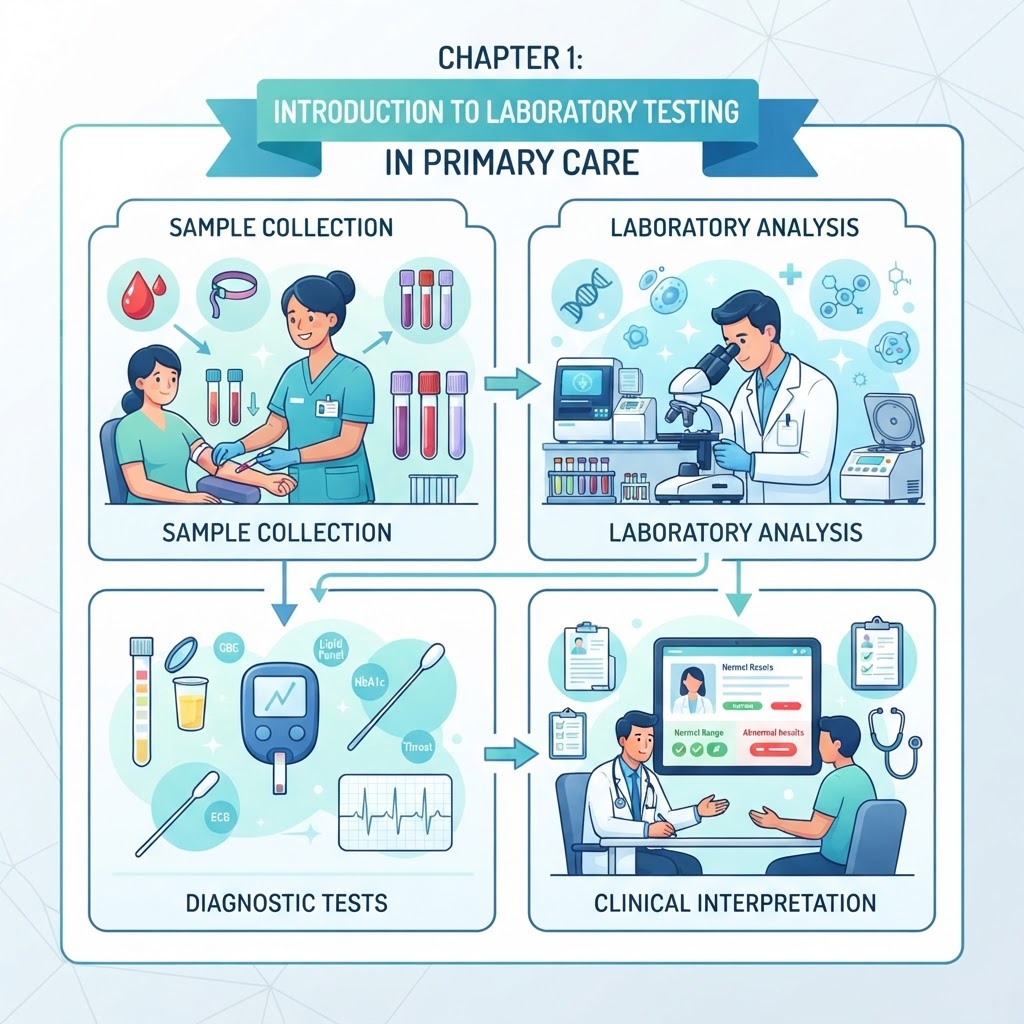
Chapter 1: Introduction to Laboratory Testing in Primary Care
Introduction
In the dynamic environment of primary care, the Family Nurse Practitioner (FNP) serves as the frontline of diagnostic medicine. Laboratory testing is not merely a technical requirement; it is a clinical extension of the physical examination and a critical component of evidence-based practice. For the FNP, the laboratory is a powerful tool used to screen for occult disease, monitor the progression of chronic conditions, guide pharmacological management, and provide reassurance to patients.
However, the sheer volume of available tests can be overwhelming. The "art" of ordering a lab test lies in the transition from screening (looking for disease before symptoms) to diagnostic (confirming a suspected condition). This chapter establishes the foundational framework for FNPs to approach laboratory medicine with clinical intelligence, skepticism, and cost-consciousness.
The Role of the FNP in Laboratory Stewardship
As an Advanced Practice Provider (APP), your responsibility extends beyond the mere generation of a lab order. It encompasses the entire lifecycle of the test: selection, interpretation, communication, and action.
The Diagnostic Lifecycle
- Selection: Does the test have high enough sensitivity and specificity for the suspected pathology?
- Preparation: Did the patient require fasting? Are there interfering medications (e.g., biotin interference in thyroid assays)?
- Interpretation: Is the result clinically significant, or is it a statistical outlier within the reference range?
- Communication: How will the result be translated into a language the patient understands?
- Action: What is the next clinical step? (e.g., repeat in 3 months, refer to a specialist, or initiate medication).
Clinical Pearl: Never order a test if you do not have a pre-test plan for what you will do with the result. If a positive result does not change your management, the test was likely unnecessary.
Clinical Decision-Making Frameworks
The FNP must employ a systematic approach to diagnostic testing to avoid the pitfalls of "shotgun ordering."
1. Pre-Test Probability (Bayes’ Theorem)
Before ordering a test, consider the pre-test probability—the likelihood the patient has the disease based on history and physical exam.
- High pre-test probability: A positive test result confirms the diagnosis (a "rule-in" test).
- Low pre-test probability: A negative test result effectively rules out the diagnosis (a "rule-out" test).
- The "Grey Zone": Testing patients with a 50% pre-test probability often leads to ambiguous results that require further, often invasive, testing.
2. The Choosing Wisely Initiative
The Choosing Wisely campaign provides invaluable guidelines for reducing low-value care. FNPs should regularly consult these resources to ensure that they are not ordering tests that offer little clinical benefit, such as routine preoperative labs for low-risk procedures or repeat lipid panels more frequently than clinical guidelines suggest.
Understanding Reference Ranges and "Normal"
A common error among novice clinicians is the belief that a "normal" lab result equals a "healthy" patient.
The Statistical Reality
Most reference ranges are based on a Gaussian distribution, representing the middle 95% of the healthy population. By definition, 2.5% of healthy individuals will fall above the upper limit, and 2.5% will fall below the lower limit.
- Clinical Scenario: You see a 45-year-old patient with an isolated slightly elevated AST of 42 IU/L (reference range 10-40). Is this clinical pathology, or is the patient simply an outlier?
- FNP Action: Compare the current result to historical trends. An isolated value, while technically "high," may be the patient’s personal baseline. Look for concomitant abnormalities (e.g., ALT, GGT, or symptoms of alcohol use or metabolic syndrome) before labeling it a disease.
Cost-Effective Test Selection
In primary care, resource stewardship is a professional duty. Unnecessary testing incurs costs for the patient, increases the burden of administrative follow-up, and contributes to the risk of "incidentalomas"—benign findings that lead to anxiety, additional testing, and potential iatrogenic harm.
Best Practices for Cost-Effectiveness
- Avoid "Panel Fatigue": Do not order a Complete Metabolic Panel (CMP) when a Basic Metabolic Panel (BMP) is sufficient.
- Time-Bound Follow-up: If you suspect a benign cause for an elevation (e.g., a slightly high potassium due to hemolyzed blood), repeat the test before ordering expensive downstream investigations.
- Electronic Health Record (EHR) Defaults: Be wary of pre-configured "order sets" in your EHR. They often contain extraneous tests that are not relevant to every patient.
Interpretation of Abnormal Values: A Case-Based Approach
Case Scenario 1: The Incidental Anemia
Patient: 52-year-old female presents for annual physical. Lab: Hemoglobin 11.2 g/dL (Low), MCV 74 fL (Low). Clinical Assessment: This is a classic microcytic anemia. Decision Tree:
- Identify: What is the iron status? (Order Ferritin, Iron, TIBC).
- Contextualize: If Ferritin is low, assume iron deficiency. Do not stop here.
- Investigate: In a 52-year-old, iron deficiency is rarely "just diet." Screen for occult GI blood loss or menorrhagia.
- Clinical Pearl: Always consider the why behind the lab result. A lab result is a signpost, not a diagnosis.
Case Scenario 2: The Diabetic Monitoring
Patient: 60-year-old with T2DM. Lab: HbA1c 7.1%. Interpretation: This is an improvement from 7.8% three months ago. Action: Do not immediately increase metformin. The trend is positive. Reinforce lifestyle interventions.
- Clinical Pearl: Treat the patient, not the number. If a patient has an HbA1c of 7.1% but is experiencing frequent hypoglycemic episodes, the clinical goal is to increase the target, not to add more medication.
Common Laboratory Pitfalls in Primary Care
1. The "Biotin" Interference
Many patients take high-dose biotin (vitamin B7) for hair and nail health. Biotin interferes with immunoassays, particularly those involving thyroid function tests (e.g., TSH and Free T4) and troponin.
- FNP Action: Instruct patients to stop all biotin-containing supplements 48–72 hours before blood draws for endocrine labs.
2. Hemolysis
Hemolysis in a sample can falsely elevate potassium, LDH, and AST.
- FNP Action: If a result is wildly inconsistent with the patient's clinical presentation (e.g., a potassium of 6.2 in an asymptomatic patient), order a repeat test before initiating clinical intervention.
3. Chronic Kidney Disease (CKD) and Creatinine
Serum creatinine is a lagging indicator of kidney function. In the elderly, a "normal" creatinine can mask significant CKD because of low muscle mass.
- FNP Action: Always calculate the eGFR (estimated Glomerular Filtration Rate). If the patient is on the verge of the next CKD stage, interpret the eGFR trend rather than a single point in time.
Communicating Results to Patients
The FNP’s job is not complete until the patient understands what the results mean for their health.
Best Practices for Patient Communication
- The "Sandwich" Technique: If a result is abnormal, lead with the finding, explain the significance in plain language, and finish with the plan.
- Use Visuals: Show the patient their trend line on a graph if the EHR supports it. Seeing their blood pressure or HbA1c trend down over time is a powerful motivator.
- Manage Expectations: Explicitly tell patients, "Not all tests result in an immediate change in medication."
Summary of Clinical Pearls
- Pre-test probability is king: If you don't know why you are ordering a test, don't order it.
- Trends > Single Values: An abnormal lab result that is moving toward the reference range is often more important than a slightly out-of-range value that remains stable.
- Contextualize: Always relate lab values to the patient’s age, comorbidities, and medication list.
- Avoid the "Incidentaloma": Educate patients on why we don't need to chase every minor laboratory deviation.
- Documentation: Document your rationale for ordering the test and your interpretation of the result in the clinical note. This is essential for both continuity of care and legal protection.
Chapter Summary
In this chapter, we have established that laboratory testing is an essential, yet often overused, component of primary care. For the Family Nurse Practitioner, the goal is to become a "diagnostic architect"—selecting only the tests that will provide actionable data, interpreting them within the context of the individual patient, and effectively communicating the significance of these results.
By applying the frameworks of pre-test probability, cost-effective stewardship, and a cautious approach to reference ranges, the FNP can significantly improve diagnostic accuracy while minimizing the harm associated with unnecessary over-testing. As we move through the subsequent chapters, keep these foundational principles at the forefront of your practice. Laboratory medicine is not about finding the perfect number; it is about gathering the right information to make the best possible clinical decision for your patient.
Self-Assessment Questions for the Practitioner
- How does Bayes' Theorem change the way you approach a patient who requests a "full body checkup" of blood work?
- What are three common medications that might interfere with standard laboratory results?
- If you receive a lab result that is "technically abnormal" but clinically irrelevant, how do you document this to avoid confusion for future providers?
- What is the most effective way to explain a "normal" result to a patient who remains convinced they have a serious illness?
(Note: This chapter is intended for educational purposes and should be used in conjunction with current clinical guidelines from organizations such as the AAFP, ADA, and ACP.)
💡 Key Takeaways
- Laboratory testing acts as a critical extension of the physical examination in primary care.
- Tests serve four main clinical functions: screening for disease, monitoring chronic conditions, guiding pharmacology, and providing patient reassurance.
- Effective clinical practice requires discerning when to use tests for screening versus diagnostic confirmation.
- FNPs must approach laboratory ordering with clinical intelligence, skepticism, and a focus on cost-consciousness.
🧠 Sign in to take the chapter quiz