Pharmacology in Primary Care Management by Family Nurse Practitioner
Chapter 1 of 15 • 40m
Chapter 1: Introduction to Pharmacology in Primary Care
Overview of pharmacology principles for the FNP, pharmacokinetics, pharmacodynamics, the prescribing process, legal and ethical considerations, and medication safety in primary care.
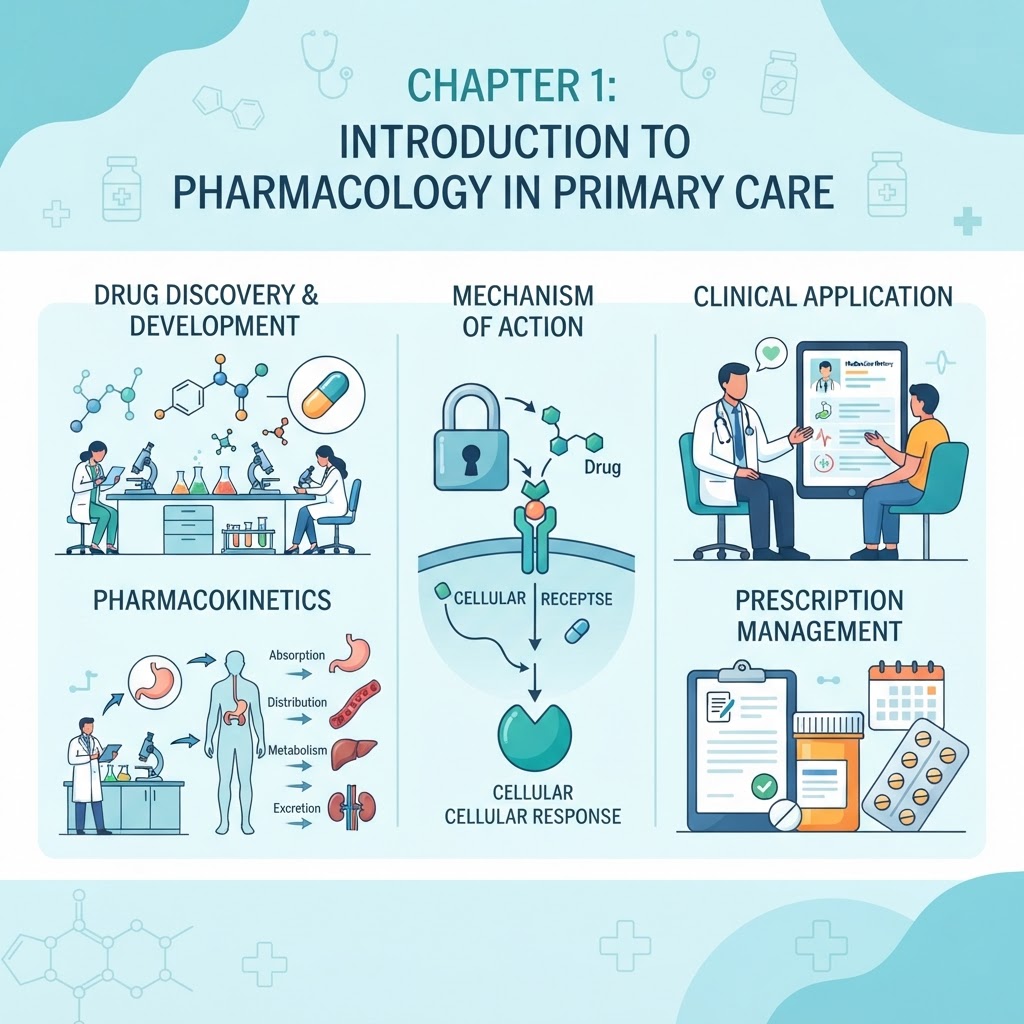
Chapter 1: Introduction to Pharmacology in Primary Care
Introduction
For the Family Nurse Practitioner (FNP), pharmacology is the cornerstone of patient management. Unlike the specialized clinician who may focus on a narrow therapeutic class, the FNP operates at the intersection of acute care, chronic disease management, and preventative health. Mastering pharmacology requires more than memorizing drug names; it demands a deep understanding of how medications interact with human physiology, how to navigate the legal landscape of prescribing, and how to minimize the inherent risks of polypharmacy in a diverse patient population ranging from pediatrics to geriatrics. This chapter serves as the foundational framework for the safe, effective, and ethical application of pharmacotherapy in the primary care setting.
Principles of Pharmacokinetics and Pharmacodynamics
To prescribe safely, the FNP must understand what the body does to the drug (pharmacokinetics) and what the drug does to the body (pharmacodynamics).
Pharmacokinetics (ADME)
- Absorption: The movement of a drug from the site of administration into the bloodstream. In primary care, factors like gastric pH, age (slower gastric emptying in the elderly), and drug-drug interactions (e.g., antacids reducing absorption of fluoroquinolones) are critical.
- Distribution: How the drug reaches tissues. FNPs must consider protein binding. If a patient is hypoalbuminemic (often seen in elderly or malnourished patients), the "free" fraction of a highly protein-bound drug increases, raising the risk of toxicity.
- Metabolism: Primarily occurring in the liver via the Cytochrome P450 (CYP450) enzyme system. FNPs must be vigilant regarding CYP450 inducers (which lower drug levels) and inhibitors (which raise drug levels and risk toxicity).
- Excretion: Mostly renal. The FNP must routinely calculate the Estimated Glomerular Filtration Rate (eGFR) or Creatinine Clearance (CrCl) before prescribing, particularly for renally cleared medications like metformin or lisinopril.
Pharmacodynamics
This involves the drug-receptor interaction. Most drugs work by binding to receptors, acting as either agonists (mimicking natural substances) or antagonists (blocking receptor activity). Understanding the "therapeutic window"—the space between the minimum effective concentration and the toxic concentration—is vital for drugs like lithium, warfarin, and digoxin.
The Prescribing Process: A Clinical Approach
Effective prescribing in primary care follows a structured decision-making process:
- Define the Diagnosis: Never prescribe without a clear clinical indication.
- Define the Therapeutic Goal: Are we curing (antibiotics), managing symptoms (analgesics), or preventing (statins)?
- Choose the Appropriate Medication: Consider efficacy, safety, cost, and patient adherence.
- Initiate Therapy at an Appropriate Dose: The mantra "start low, go slow" is essential, especially for geriatric patients.
- Monitor: Evaluate for efficacy and adverse effects.
- Educate: Ensure the patient understands the why, how, and when of their medication.
Legal and Ethical Considerations
Prescribing is a delegated authority that carries significant legal weight.
- Scope of Practice: Practice authority varies by state (Full, Reduced, or Restricted). Always be aware of your state’s specific requirements regarding collaborative practice agreements.
- Controlled Substances: FNPs must register with the DEA. Adherence to state-specific Prescription Drug Monitoring Programs (PDMP) is mandatory to prevent diversion and identify "doctor shopping."
- Ethical Prescribing: This includes avoiding the over-prescription of antibiotics and opioids, addressing social determinants of health (e.g., prescribing a brand-name drug when a generic is available and necessary for the patient's budget), and respecting patient autonomy.
Medication Safety and Polypharmacy
Medication errors in primary care are often related to systemic issues. FNPs should employ the following:
- Medication Reconciliation: Perform this at every encounter. Compare what the patient is actually taking to what is in the Electronic Health Record (EHR).
- The Beers Criteria: Use the American Geriatrics Society (AGS) Beers Criteria for Potentially Inappropriate Medication Use in Older Adults to guide safer prescribing for the elderly.
- High-Alert Medications: Pay special attention to insulin, anticoagulants, opioids, and psychotropics. Ensure frequent follow-up for these classes.
Case Scenario: Applying Pharmacological Principles
Patient: 74-year-old female with hypertension, type 2 diabetes (eGFR 48 mL/min/1.73m²), and GERD. Presentation: She is currently taking Lisinopril, Metformin, and Omeprazole. She reports new onset of persistent dry cough.
Clinical Reasoning:
- Assessment: The cough is likely an adverse effect of the ACE inhibitor (Lisinopril).
- Pharmacology: ACE inhibitors prevent the breakdown of bradykinin, leading to respiratory irritation.
- Management: Discontinue Lisinopril. Switch to an Angiotensin II Receptor Blocker (ARB) like Losartan, which does not increase bradykinin.
- Safety Check: Her eGFR is 48. Metformin is safe to continue, but her renal function must be monitored annually. Omeprazole can interfere with B12 absorption; monitor for deficiency.
Clinical Pearls for the FNP
- The "Brown Bag" Method: Encourage patients to bring all medications (including OTC and herbal supplements) in a bag to their visit. Herbals like St. John’s Wort can have profound interactions with SSRIs or warfarin.
- Cost-Effectiveness: Always check the formulary. Use resources like GoodRx or local pharmacy lists to help patients find affordable options, which directly improves adherence.
- "Prescribing Cascade": Be wary of treating a side effect of one drug with a second drug. Always ask, "Is this new symptom actually a reaction to an existing medication?"
- Documentation: If a patient refuses a standard of care medication, document the patient’s reasoning and your education provided regarding the risks of non-adherence.
Summary Table: Key Pharmacological Concepts
| Concept | Primary Care Application | | :--- | :--- | | Pharmacokinetics | Adjust doses based on renal/hepatic function. | | Polypharmacy | Aim to discontinue one drug for every one added. | | Safety | Utilize PDMP and Beers Criteria. | | Adherence | Simplify regimens to increase compliance. | | Monitoring | Establish specific targets (e.g., A1c, BP, INR). |
Chapter Summary
Pharmacology in primary care is a dynamic discipline that requires the FNP to balance evidence-based medicine with the unique psychosocial realities of each patient. By grounding practice in the fundamentals of pharmacokinetics and pharmacodynamics, adhering to legal standards, and actively managing the risks of polypharmacy, the FNP ensures patient safety while optimizing health outcomes. As the landscape of medicine changes, the FNP’s commitment to lifelong learning in pharmacology remains the most powerful tool in the clinician’s kit.
Key Chapter Takeaways:
- Always assess renal and hepatic function before initiating new therapies.
- Medication reconciliation is a patient safety imperative, not an administrative task.
- Prescribing involves balancing therapeutic intent with the potential for adverse effects and drug-drug interactions.
- Standardize your prescribing process to minimize errors and document clinical rationale thoroughly.
- Prioritize the Beers Criteria when managing the geriatric population to prevent adverse drug events.
💡 Key Takeaways
- Pharmacology serves as a foundational pillar for Family Nurse Practitioners in managing acute, chronic, and preventative patient care.
- Effective prescribing requires a deep comprehension of how medications interact with human physiology beyond simple memorization.
- Practitioners must navigate complex legal requirements and ethical considerations to ensure safe pharmacotherapy.
- Mitigating the risks of polypharmacy is essential when treating diverse patient populations spanning from pediatrics to geriatrics.
🧠 Sign in to take the chapter quiz