The NAZCA Lines: Insight Knowledge
Chapter 1 of 15 • 45m
Chapter 1: Discovery and Early Exploration of the Nazca Lines
The accidental discovery of the Nazca Lines from the air, early explorers like Toribio Mejía Xesspe and Paul Kosok, and the pioneering aerial photography that revealed the geoglyphs.
Chapter 1: Discovery and Early Exploration of the Nazca Lines
Introduction: The Canvas of the Gods
For centuries, the arid plains of the Nazca Desert in southern Peru remained a silent, desolate expanse. To the travelers and local inhabitants traversing the coastal foothills, the landscape appeared to be nothing more than a parched, gravel-strewn plateau—a place where the wind rearranged the dark, iron-oxide-coated pebbles, and life clung stubbornly to the narrow river valleys below. It was not until the dawn of the aviation age that humanity gained the perspective necessary to realize that the ground beneath their feet was, in fact, a colossal, prehistoric canvas.
The Nazca Lines—a massive collection of over 800 straight lines, 300 geometric figures, and 70 biomorphic designs (geoglyphs)—represent one of the most profound archaeological puzzles in human history. To understand how these etchings were brought to the world’s attention, one must look at the convergence of modern technology and the dedicated, often obsessive, curiosity of early twentieth-century researchers. This chapter traces the journey from the accidental observations of pilots to the rigorous academic study that transformed these markings from mere "curiosities" into a global cultural heritage site.
The Aerial Revelation: An Accidental Discovery
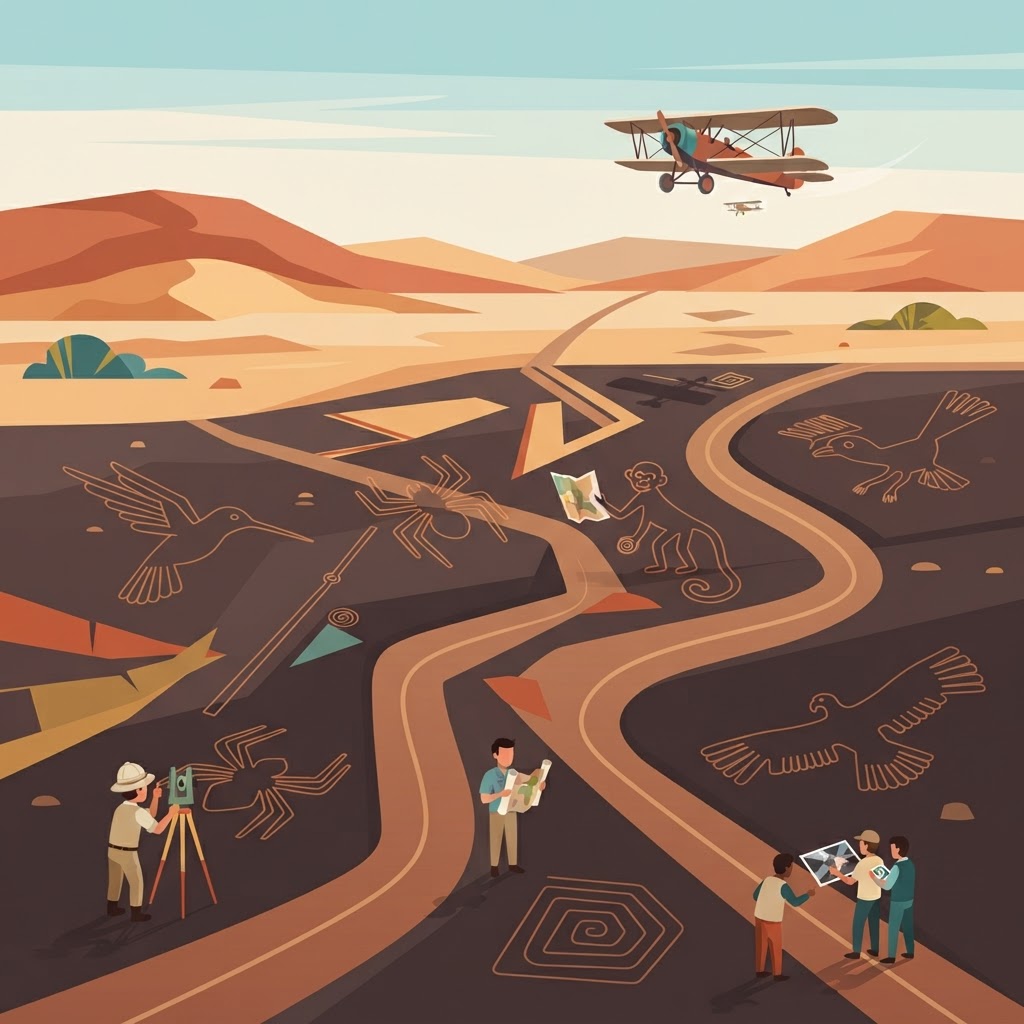
The history of the Nazca Lines is inextricably linked to the history of commercial aviation. In the late 1920s and early 1930s, as Peru began to develop its domestic flight routes between Lima and the southern provinces, pilots flying over the Pampa Colorada (the Red Plain) began to notice strange, long, straight markings on the ground.
At first, these were dismissed as nothing more than the remnants of abandoned irrigation canals or ancient trails left by the Inca. However, as flights became more frequent, pilots and passengers alike couldn't help but note the baffling geometric precision of the lines. They did not meander like natural watercourses; they sliced through hillsides, terminated abruptly, and intersected with mathematical intent.
The realization that these were man-made features—and that they were only fully legible from the sky—was the "Eureka" moment of 20th-century archaeology. It forced researchers to adopt a new methodology: aerial archaeology. Without the perspective afforded by flight, these patterns would have remained hidden in plain sight, fragmented and obscured by the scale of the desert floor.
Toribio Mejía Xesspe: The First Footsteps
While aviators provided the view from above, it was the Peruvian archaeologist Toribio Mejía Xesspe who conducted the first systematic, ground-level investigation. In 1927, while hiking through the hills surrounding the Nazca valleys, Mejía Xesspe began to categorize the markings he saw.
His work was fundamental because it established that these were not just random scratches. He identified them as "sacred roads" (ceques), theorizing that they served a ceremonial purpose related to the religious life of the ancient Nazca culture. His documentation provided the first empirical evidence that these geoglyphs were human-made, dispelling early supernatural myths that suggested they were the work of extraterrestrial entities or giants.
Paul Kosok and the "World’s Largest Astronomy Book"
The narrative of the Nazca Lines shifted from local interest to international scientific prominence in 1941, thanks to the American historian and professor Paul Kosok.
While conducting research on ancient irrigation systems in Peru, Kosok took a flight over the plateau. On the winter solstice of 1941, he noticed that the sun set almost exactly at the end of one of the major lines. This coincidence led Kosok to formulate a revolutionary hypothesis: the Nazca Lines were an immense astronomical observatory. He famously dubbed the plateau "the world’s largest astronomy book."
Key Insights from Kosok’s Methodology:
- Alignment Theory: He argued that the lines were aligned with the positions of the sun, moon, and stars during important agricultural events.
- The Calendrical Purpose: He suggested that the lines acted as a giant calendar, helping the Nazca people time the planting and harvesting of crops in a climate where water was a precious, unpredictable resource.
- Ceremonial Connectivity: He noted that the lines were often located near cahuchis (ceremonial centers), suggesting that the act of walking the lines was a form of ritual movement.
Pioneering Aerial Photography: Unveiling the Patterns
Following Kosok, the study of the lines moved into an era of advanced documentation. The challenge for early researchers was that the lines were fragile. The Nazca desert is composed of a light-colored ground covered by a thin layer of dark, manganese-coated volcanic pebbles. By simply removing the top layer of rocks, the ancient Nazca revealed the lighter-colored soil beneath.
Because there is almost no rain, wind, or vegetation in this hyper-arid environment, these "negative" drawings have remained preserved for nearly 2,000 years. Early aerial photography—conducted using heavy, large-format cameras mounted to the undersides of small propeller planes—allowed researchers to map these figures for the first time.
The primary types of geoglyphs identified during this early phase included:
- Geometric Figures: Trapezes, rectangles, triangles, and spirals.
- Biomorphic Figures: The famous depictions of animals and plants, including the spider, the monkey, the hummingbird, and the condor.
- Straight Lines: Some extending for several miles, showing incredible lateral accuracy that suggests the use of basic surveying tools like sighting stakes and ropes.
Archaeological Context: Who Built Them and Why?
The early explorers established that the lines were created between 500 BCE and 500 CE by the Nazca culture. The Nazca were master potters and weavers, living in a valley that relied on a sophisticated underground aqueduct system (puquios).
The early consensus reached by researchers like Mejía Xesspe and Kosok pointed to a "Ritualistic-Hydrological" theory. In the eyes of these ancient people, the act of creating the lines was as important, if not more so, than the final image itself. The desert became a place of dance, prayer, and pilgrimage. Pilgrims would walk along the straight lines, leaving offerings at the intersections, likely pleading with the deities for rain and fertility.
Best Practices for Studying Ancient Geoglyphs
For the modern student of archaeology, the history of the Nazca Lines offers several key takeaways regarding field research:
- Interdisciplinary Approaches: The study of the lines requires an overlap of archaeology, astronomy, geology, and art history.
- Preservation Awareness: The lines are extremely sensitive to human impact. Early explorers realized that even a footprint can remain for decades, a lesson that informs modern site management.
- Respect for Cultural Intent: Modern researchers caution against projecting Western astronomical concepts onto ancient cultures, emphasizing that the "science" of the Nazca was inextricably tied to their spiritual reality.
Chapter Summary
The discovery of the Nazca Lines represents a unique moment where technology allowed us to "see" a lost civilization's grandest expression. From the accidental sightings by early commercial pilots to the academic rigor of Toribio Mejía Xesspe and the astronomical breakthroughs of Paul Kosok, the lines were slowly stripped of their mystery and placed within their rightful historical context. These geoglyphs are not merely desert decorations; they are the enduring, earth-bound echoes of a society that sought to communicate with the heavens. They stand as a testament to the sophistication of the Nazca people and a reminder of how much of our history remains hidden, waiting for the right perspective to be revealed.
💡 Key Takeaways
- The Nazca Lines remained largely unnoticed by ground-level travelers due to the vast, arid nature of the Peruvian desert landscape.
- The advent of aviation was the critical turning point that allowed researchers to recognize the geoglyphs as intentional, large-scale designs.
- The Nazca site consists of a complex collection of over 800 straight lines, 300 geometric figures, and 70 distinct biomorphic geoglyphs.
- The lines are created through a physical contrast between dark, iron-oxide-coated surface pebbles and the lighter-colored soil beneath.
🧠 Sign in to take the chapter quiz